
Nanny Payroll Year-End Checklist Canada (2026)
Use this nanny payroll year-end checklist for Canada: reconcile 2026 CPP and EI, confirm remittances, and prep T4s before the March 1, 2027 deadline.
Nick at RoostPay
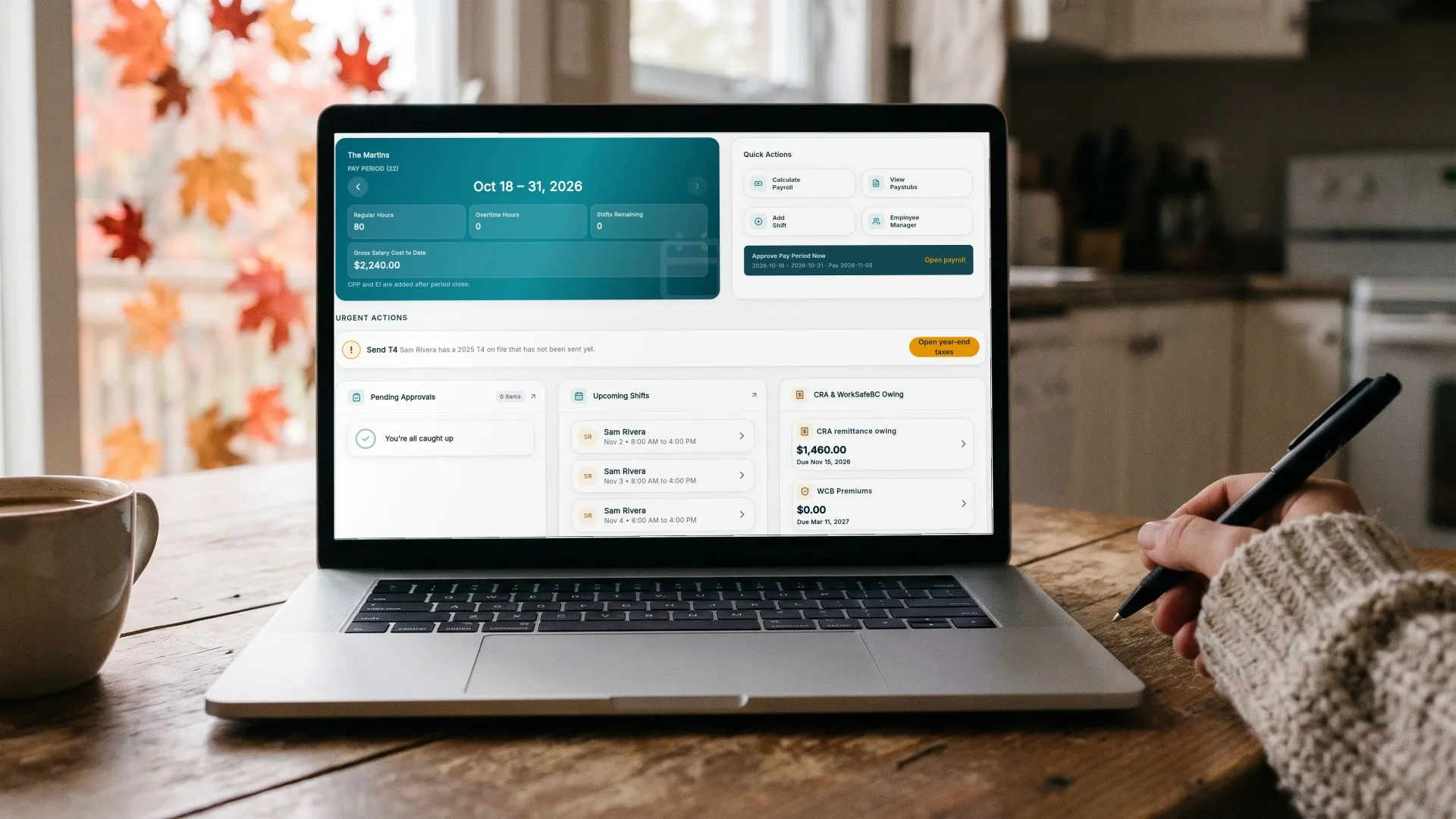
It is the first week of November. The leaves are down, the holiday schedule is filling up, and somewhere in the back of your mind is the thought that your nanny’s year-end paperwork is about to land on your plate.
At RoostPay, we calculate CPP, EI, and income tax on every pay run, keep your nanny’s year-to-date totals current, prepare the remittance amounts for each period, and prepare the T4 slips and T4 Summary for you to file with the CRA at year end. You still remit the money and file the return yourself, outside the app. What this guide gives you is the short list of things to check in November, while there is still time to fix anything.
This is a prep checklist, not a box-by-box walkthrough. For the line-by-line details of the slip itself, read our guide to filing a T4 slip for your nanny in Canada. If you are still confirming whether you count as an employer at all, start with do I need to pay taxes for my nanny in Canada.
This post is general information for the 2026 tax year, not legal or tax advice. Where a rule depends on your province, we say so.
The year-end timeline at a glance
| When | What happens | Source |
|---|---|---|
| November | Reconcile year-to-date totals, confirm remitter type, check employee details | This checklist |
| Last pay date in 2026 | Last paycheque that counts on the 2026 T4 | CRA, RC4120 |
| January 15, 2027 | December remittance (monthly remitters) and Q4 remittance (quarterly remitters) due | CRA, When to remit |
| Monday, March 1, 2027 | T4 slips to your nanny and T4 filing with the CRA due | CRA, When to file information returns |
The March date surprises people. The CRA due date is the last day of February, but February 28, 2027 is a Sunday, so the CRA’s next-business-day rule moves it to Monday, March 1, 2027.
Step 1: Reconcile your year-to-date totals
Pull up every pay stub from January through your most recent pay run and compare the totals to your payroll records. You are looking for three things:
- Gross pay matches. The sum of the gross on each stub should equal what you actually paid your nanny.
- CPP and EI are on track. They should match what you would expect from the 2026 rates below.
- Income tax withheld is reasonable. If your nanny’s hours changed a lot this year, check that the withholding still reflects what they will owe.
Here are the 2026 figures to check against:
| 2026 item | Figure | Source |
|---|---|---|
| CPP, Year’s Maximum Pensionable Earnings | $74,600 | CRA, CPP contribution rates, maximums and exemptions |
| CPP, basic exemption | $3,500 | CRA, CPP contribution rates, maximums and exemptions |
| CPP rate, employee and employer each | 5.95% | CRA, CPP contribution rates, maximums and exemptions |
| CPP maximum contribution, each | $4,230.45 | CRA, CPP contribution rates, maximums and exemptions |
| CPP2, additional maximum pensionable earnings | $85,000 | CRA, CPP2 rates and maximums |
| CPP2 rate, employee and employer each | 4% | CRA, CPP2 rates and maximums |
| CPP2 maximum contribution, each | $416 | CRA, CPP2 rates and maximums |
| EI maximum insurable earnings | $68,900 | CRA, EI premium rates and maximums; ESDC, 2026 maximum insurable earnings |
| EI employee premium rate | 1.63% | CRA, EI premium rates and maximums |
| EI maximum employee premium | $1,123.07 | CRA, EI premium rates and maximums |
| EI employer premium | 1.4 times the employee premium | CRA, EI premium rates and maximums |
A worked example
Say your nanny earns a steady $1,000 per week for all 52 weeks of 2026, so $52,000 total. Here is what the year should look like on their T4 (income tax depends on their TD1 claim, so we leave it out):
- CPP, employee: ($52,000 minus the $3,500 basic exemption) x 5.95% = $48,500 x 5.95% = $2,885.75. That is below the $4,230.45 maximum, so contributions run all year. The employer matches it, another $2,885.75.
- CPP2: $52,000 is below the $74,600 ceiling, so no CPP2 applies.
- EI, employee: $52,000 x 1.63% = $847.60, below the $1,123.07 maximum.
- EI, employer: $847.60 x 1.4 = $1,186.64.
If your totals are far from these, that is your sign to look closer. The exact per-period amounts can vary by a few cents because contributions are calculated each pay period and rounded, so do not worry about tiny differences. To check a different wage or schedule, run it through our Canadian nanny tax calculator.
Contribution caps matter if your nanny earns more. Once their pensionable earnings pass $74,600, base CPP stops, and CPP2 begins on earnings up to $85,000. EI stops once insurable earnings reach $68,900. If you see deductions continuing past those points, flag it before December.
RoostPay tracks these year-to-date totals for you after every run. If you switched to RoostPay partway through the year, you can enter opening balances for what was already withheld, so your year-end totals still add up. If you are moving over from another provider, see our Canadian nanny payroll software page for how RoostPay compares.
Step 2: Remember the “paid, not earned” rule
This one catches families every year. The CRA reports income on the T4 for the year it was paid, not the year it was earned (CRA, RC4120). That means:
- A paycheque you issue on January 2, 2027 for work done in late December belongs on the 2027 T4.
- A paycheque you issue on December 30, 2026 for the final week of the year belongs on the 2026 T4.
Decide now which pay date you want for the last period of the year, and tell your nanny. It affects their tax year and your remittance timing.
Provincial rules about vacation pay and holiday pay can also change what you owe at year end, and those rules differ by province. Check your province’s employment standards for what to pay out and when, and make sure anything you do pay is run through payroll so it lands on the right T4. December’s statutory holidays are a common trip-up; our guides to statutory holiday pay for nannies in Ontario and statutory holiday pay for nannies in BC walk through the math.
Step 3: Confirm your remittances are on schedule
If your nanny is your employee, you withhold CPP, EI, and income tax from their pay (CRA, Payments to caregivers, babysitters and domestic workers). Remitting means sending the CPP, EI, and income tax you withheld, plus your employer share of CPP and EI, to the CRA.
Know your remitter type, because it sets your due dates (CRA, When to remit and Types of remitters):
| Remitter type | How it works | Due dates |
|---|---|---|
| Regular (monthly) | Remit each month | The 15th of the following month |
| Quarterly | Remit once a quarter, for eligible small employers | April 15, July 15, October 15, and January 15 |
In both cases, the last remittance of the 2026 year, December for monthly remitters and October to December for quarterly remitters, is due January 15, 2027. If that date falls on a weekend or CRA-recognized holiday, payment is on time if it is received at a Canadian financial institution on or before the next business day.
The CRA generally decides your remitter type from your average monthly withholding amount from two calendar years ago. Quarterly remitting is for small employers with a perfect compliance record on all payroll and GST/HST accounts. A new employer qualifies when monthly withholding is under $1,000. An existing employer with a payroll account open at least 12 months qualifies when its average monthly withholding from two years ago was under $3,000, and the CRA confirms this in writing. Check your CRA My Business Account to confirm what you are assigned, rather than assuming.
RoostPay prepares the remittance amounts for each period so you know what to send. You send the payment to the CRA yourself, and RoostPay does not remit it for you.
Step 4: Check your nanny’s details before T4 season
You cannot prepare a clean T4 with missing information. In November, confirm:
- Their legal name matches their Social Insurance Number card exactly.
- Their SIN is on file and correct.
- Their mailing address is current. If they moved this year, update it now, not in February.
- Their TD1 forms (federal and provincial) are on file and still accurate.
When you generate year-end documents in RoostPay, the app lists anything missing from an employee’s profile, such as a SIN or address, before you can generate. Fixing it in November means no scramble in February.
If your nanny is leaving at the end of the year, you will also need to issue a Record of Employment for your nanny so they can apply for EI.
Step 5: Know the T4 rules you are preparing for
You do not need the full box walkthrough yet, but you should know the ground rules (CRA, T4 slip information for employers and RC4120):
- You must issue a T4 if you withheld CPP, EI, or income tax. Under CRA administrative policy, you also issue one if total remuneration for the year was more than $500, even with no deductions.
- The T4 slips and T4 Summary are due on the last day of February. For the 2026 tax year, that moves to Monday, March 1, 2027.
- You must give your nanny their T4 by the same date.
Late penalties are real, but they are manageable if you plan:
- Under the CRA’s relieving administrative policy for late T4 filing, a late return with 1 to 5 slips carries a flat $100 penalty (CRA, When to file information returns).
- Failing to give your employee their T4 on time costs $25 per day per slip, with a minimum of $100 and a maximum of $2,500 (CRA, RC4120).
In January or February, RoostPay prepares each T4 slip and the T4 Summary as a CRA XML filing package plus PDF slips for your nanny. You download the package and submit the XML to the CRA through Internet File Transfer or your My Business Account, then give your nanny their PDF. For the details of what goes in each box, our nanny T4 slip guide covers it.
The same year-end totals also feed your own tax return. Your nanny’s wages, plus the employer CPP and EI you paid, can count toward the child care expense deduction. See our guide to claiming nanny child care expenses on Form T778.
Your November checklist
Print this or paste it into your notes app:
- Compare year-to-date gross, CPP, and EI against your records and the 2026 limits
- Check income tax withheld still fits your nanny’s situation
- Decide the pay date for the last period of 2026, and which T4 year any January payment belongs to
- Confirm your remitter type in your CRA My Business Account
- Mark January 15, 2027 for the December or Q4 remittance
- Confirm your nanny’s name, SIN, address, and TD1 forms
- Put Monday, March 1, 2027 on the calendar for the T4 slips and filing
- Check your province’s rules for vacation and holiday pay owing at year end
- Save your year-end pay stubs and remittance confirmations in one folder
Frequently Asked Questions
When should I start year-end payroll prep for my nanny?
November is a good time to start. You still have time to fix any mistakes before the calendar year closes, and the December remittance and the T4 deadline are both close behind. For the 2026 tax year, the CRA due date for T4 slips is the last day of February, which falls on a Sunday in 2027, so the deadline moves to Monday, March 1, 2027 (CRA, When to file information returns).
Do I have to issue a T4 if my nanny earned less than $500?
You must issue a T4 if you withheld CPP, EI, or income tax. Under CRA administrative policy, you also issue one when total remuneration for the calendar year was more than $500, even if nothing was withheld (CRA, T4 slip information for employers and RC4120).
Which year does a January paycheque for December work belong to?
The year it was paid. The CRA says income is reported on the T4 for the year you pay it, not the year it was earned, so a paycheque issued in January for December work belongs on next year’s T4 (CRA, RC4120).
When are my December nanny payroll remittances due?
If you remit monthly, the December remittance is due January 15, 2027. If you are a quarterly remitter, the October to December remittance is also due January 15, 2027. When that date lands on a weekend or CRA-recognized holiday, the payment is on time if it is received by the next business day (CRA, When to remit).
Year-end does not have to be a scramble. With running totals, remittance amounts, and T4 documents prepared for you, the work left is the part only you can do: sending the payments and filing.
Ready to start the year-end checklist with your numbers already in order? Start your free 30-day trial and run compliant Canadian nanny payroll on one flat plan: CA$24/month or CA$228/year, with unlimited employees. See everything included on the features page.
