
Hire your own attendant or support worker? Here’s how payroll works
You found an attendant or support worker you trust, and you pay them yourself. Once you set their hours and direct their work, you are usually their employer, whether you pay them out of your own pocket or through a self-managed funding program.
This page is for people who pay their worker directly, including when a placement agency introduced them. It isn’t for care where an agency employs the worker and handles payroll. RoostPay calculates the payroll math either way.
No charges for 30 days · Cancel anytime

Which path are you on?
Your CRA payroll duties are the same either way. The difference is where the money comes from and whether you owe a report to a program.
| Path | Where the money comes from | Extra reporting | Where to start |
|---|---|---|---|
| Paying privately | Where the money comes from Your own money | Extra reporting None. The CRA and your province are the only rules. | Where to start Start with Part 1 → |
| A self-managed program | Where the money comes from Funding from your health authority or the province | Extra reporting A program report on how the funding was spent, on top of the usual CRA duties. | Where to start Start with Part 2 → |
Part 1
Paying an attendant with your own money
Are you the employer?
The CRA treats you as an employer when you hire the person, set their regular working hours, and assign and supervise their tasks. That test applies the same way whether the worker is called an attendant, a support worker, or a personal care assistant.
Setting up CRA payroll
Register for a CRA payroll program account so you can withhold and remit income tax, CPP, and EI when they apply. For 2026, outside Quebec, the federal figures are:
| Contribution | Withheld from your caregiver | You pay as the employer | Applies to |
|---|---|---|---|
| CPP (Canada Pension Plan) | Withheld from your caregiver 5.95% | You pay as the employer 5.95% | Applies to Pay up to $74,600 a year, after a $3,500 basic exemption |
| CPP2 (second CPP contribution) | Withheld from your caregiver 4% | You pay as the employer 4% | Applies to Pay above $74,600, up to $85,000 a year |
| EI (Employment Insurance) | Withheld from your caregiver 1.63% | You pay as the employer 2.282% | Applies to Insurable earnings up to $68,900 a year. Employer EI is 1.4 times the employee premium, not a matching share. CPP and CPP2 are the same rate for both of you. |
2026 federal rates, outside Quebec. Quebec uses reduced EI rates and QPIP, so confirm current figures with the CRA before you remit.
RoostPay works these numbers out on every pay run and gives you a pay stub, a T4 at year-end, and an ROE if the employment ends. You still send the money to the CRA yourself.
Do you need workers’ compensation coverage?
| Province | Coverage for an attendant |
|---|---|
| Ontario (WSIB) | Coverage for an attendant Not required when a private individual directly employs an attendant for personal or physical care. Optional coverage is available for you or your worker. |
| British Columbia (WorkSafeBC) | Coverage for an attendant Generally required once a home health worker is on for 8 or more hours a week. |
Check with WSIB, WorkSafeBC, or your provincial board if your situation doesn’t fit neatly into these categories.
Can you pay a family member?
The answer depends on where your money comes from. A funding program’s own family-pay rule applies, and it is often stricter than CRA rules alone.
| Situation | Can a relative be paid? |
|---|---|
| Paying privately | Can a relative be paid? CPP generally still applies to a paid relative who is an employee. EI depends on whether the CRA would treat the arrangement as arm’s length. |
| Alberta Self-Managed Care | Can a relative be paid? Family, friends, and informal caregivers can’t be hired as paid providers. |
| BC CSIL | Can a relative be paid? Immediate family (a parent, child, or spouse) only with an exception approved by your health authority. A client support group member or representative can’t also be a paid worker. |
Ask the CRA for a ruling if you are unsure. For funded programs, confirm the current rule with your case manager or health authority before you hire a relative.
Part 2
Using a self-managed funding program
Programs like BC’s Choice in Supports for Independent Living (CSIL) and Alberta Self-Managed Care give you funding so you can hire and pay your own workers. You are still the employer, and you still handle CRA payroll. The program adds one more thing: its own report on how the funding was spent.
Programs with a full guide
| Program | Province | What you report | Guide |
|---|---|---|---|
| BC CSIL (Choice in Supports for Independent Living) | Province British Columbia | What you report Monthly financial report with receipts | Guide CSIL payroll in BC → |
| Alberta Self-Managed Care | Province Alberta | What you report Quarterly report on how funds were spent | Guide Alberta Self-Managed Care payroll → |
Claiming attendant care as a medical expense
Separate from payroll, the CRA lets you claim eligible attendant care as a medical expense on your tax return, including care provided in a private home. One provision caps the amount you can claim at $10,000 under specific conditions.
How RoostPay Helps with Caregiver Payroll
-
RoostPay handles
Payroll calculations (wages, CPP, CPP2, EI, income tax, vacation pay)You stay in charge
Pay your worker from your own banking or program account -
RoostPay handles
Deduction and remittance amountsYou stay in charge
Remit to the CRA yourself -
RoostPay handles
Pay stubs, T4s, ROEs, and payroll recordsYou stay in charge
Your program’s own funding or expense report, if you are in one -
RoostPay handles
One flat plan for multiple workers ($24/mo or $228/yr, unlimited employees)You stay in charge
Workers’ comp registration if it applies, and program agreement duties
RoostPay calculates each pay run, shows you what to remit, and prepares the pay stubs, T4s, and ROEs so you can pay your caregiver and send the CRA what is owed.
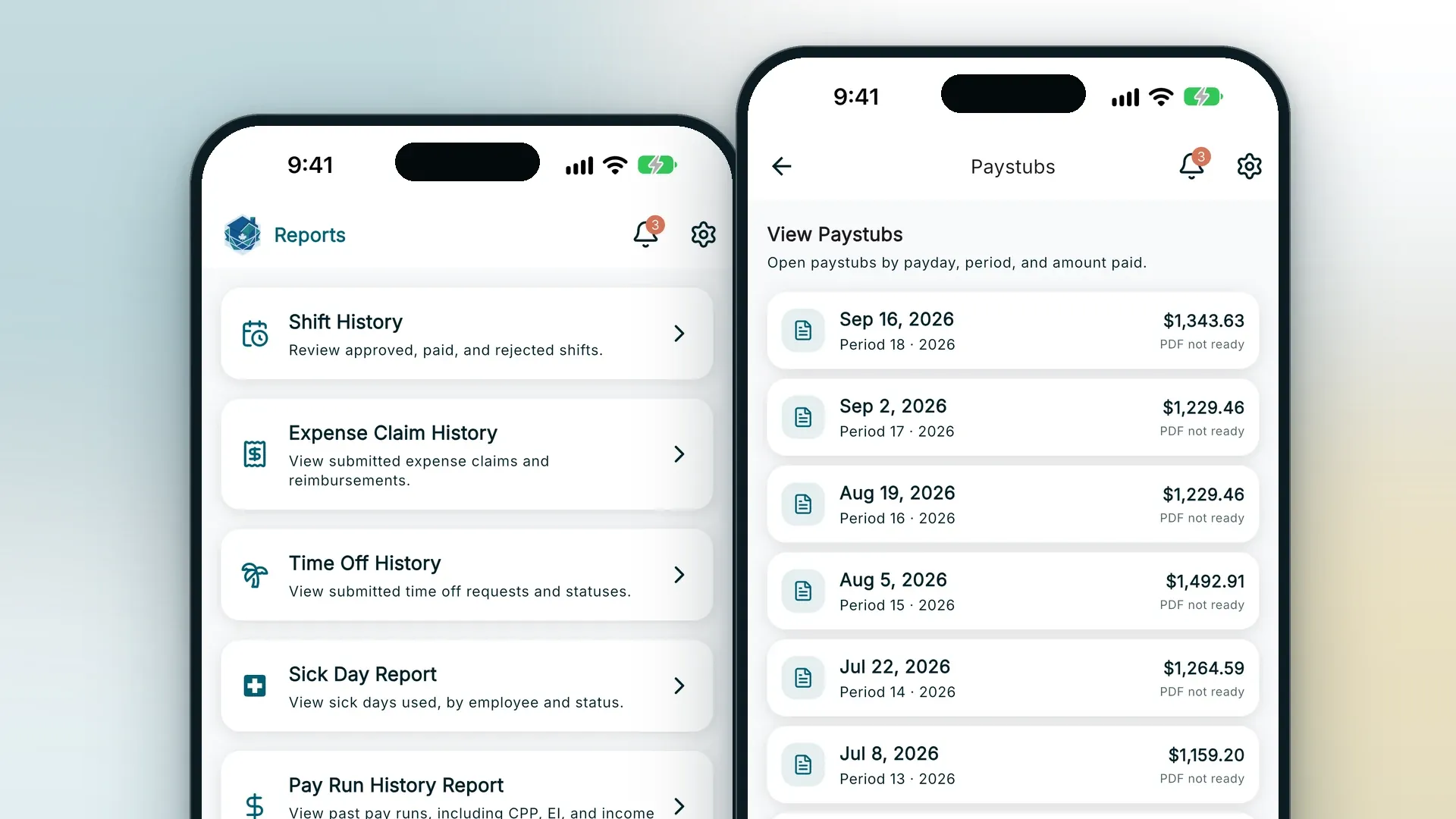
Compare Full Access for one caregiver or several.
Caregiver payroll pricingRelated caregiver payroll guides
Run attendant or support worker payroll without the spreadsheet
One plan, unlimited employees. $24/month or $228/year.
No charges for 30 days · Cancel anytime
Not ready to start? Get caregiver payroll tips by email.
Get RoostPay Insights newsletter
Frequently asked questions
Can I hire my own attendant and handle payroll myself?
Yes. If you hire the person, set their schedule, and direct their work, you are generally their employer under CRA rules, whether you pay them from your own money or through a self-managed funding program.
Do I need to register with the CRA to pay an attendant?
If you are the employer, yes. Register a CRA payroll program account so you can withhold and remit income tax, CPP, and EI when they apply, and issue pay stubs and a T4.
Does WSIB or WorkSafeBC apply if I hire an attendant?
In Ontario, a private individual who directly employs an attendant for personal or physical care is not required to register with WSIB, though optional coverage is available. In BC, WorkSafeBC generally requires coverage once a home health worker is on for 8 or more hours a week.
Can I pay a family member to be my attendant?
It depends on your funding source. If you pay privately, CPP usually still applies and EI depends on whether the CRA would treat the arrangement as arm’s length. Alberta Self-Managed Care does not allow family, friends, or informal caregivers to be paid providers. CSIL in BC allows immediate family only with an exception approved by the health authority.
What is the difference between paying privately and a self-managed funding program?
Paying privately means the money comes out of your own pocket and there is no program report to file. A self-managed program like CSIL or Alberta Self-Managed Care gives you funding to pay a worker, but adds a reporting requirement on top of the usual CRA duties.
Does RoostPay handle my CSIL or Alberta Self-Managed Care reporting?
No. RoostPay calculates payroll and gives you pay stubs, T4s, and ROEs. Your program’s own financial or expense report still goes to the health authority or case manager yourself.
Can I claim what I pay my attendant as a medical expense?
Sometimes. The CRA allows attendant care to be claimed as a medical expense under specific conditions, including a cap on the amount you can claim under one provision. This is separate from payroll and depends on your personal tax situation, so check the CRA’s attendant care rules or ask an accountant.
Sources
- CRA, employing a caregiver, baby-sitter, or domestic worker
- WSIB, industry-specific coverage
- WorkSafeBC, homeowners
- CRA, attendant care and care in a facility
- BC, Choice in Supports for Independent Living
- AHS Self-Managed Care brochure (PDF)
Last updated: 2026-09-25. This page is general information for people who hire their own attendant or support worker, and their families or representatives. It is not tax, legal, or program advice. Confirm your situation with the CRA, your provincial workers’ compensation board, and your health authority or case manager.